
Btrfs RAID 5/6: Still Don't
·
Updated:
The kernel docs still warn about it. The Btrfs wiki still warns about it. People still build it and lose data. Here's the write hole, why RAID 1/10 are fine, and what to use instead.
All the articles with the tag "raid".
The kernel docs still warn about it. The Btrfs wiki still warns about it. People still build it and lose data. Here's the write hole, why RAID 1/10 are fine, and what to use instead.

SnapRAID calculates parity on a schedule instead of in real time, so it mixes drive sizes and pairs with MergerFS. Best fit for media that rarely changes.
Creating a RAID array is the easy part. The drama starts six months later when one drive starts dying. Here's the survival guide for everything that happens after mdadm --create.
Hardware RAID controllers used to be necessary. Now they're often a liability. Here's when to flash that LSI card to IT mode, when to keep it, and why ZFS specifically refuses to share.

RAID-Z isn't just RAID 5 with a new name. Variable stripe widths, no write hole, and dRAID's distributed spares change the rebuild math entirely.
RAID 5 and 6 don't scale gracefully past 8 drives. RAID 50 and RAID 60 stripe across multiple parity sub-arrays so rebuilds only stress one group. Here's when nesting actually pays off.

Your RAID 5 rebuild on a modern multi-TB drive has a 40-50% chance of hitting a URE before it finishes. Here's the 2026 math and what to do about it.
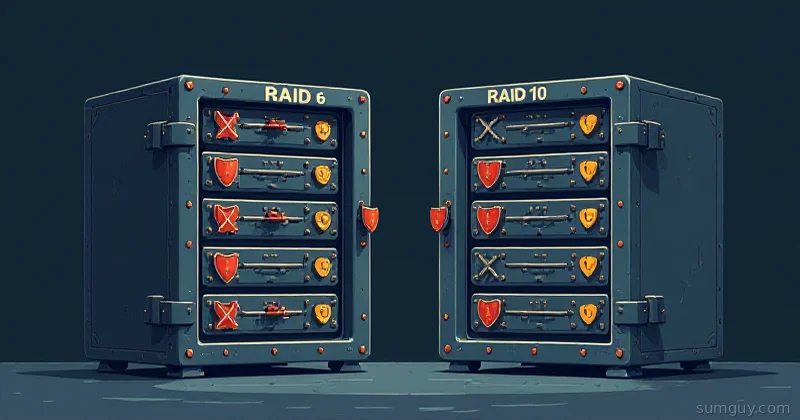
RAID 6 and RAID 10 both survive two dead disks and both need four drives. But they get there completely differently, and that difference matters.

RAID 0 is fast and terrifying, RAID 1 is boring and beautiful, RAID 5 is the NAS compromise. How to pick the right one for your home lab drives.